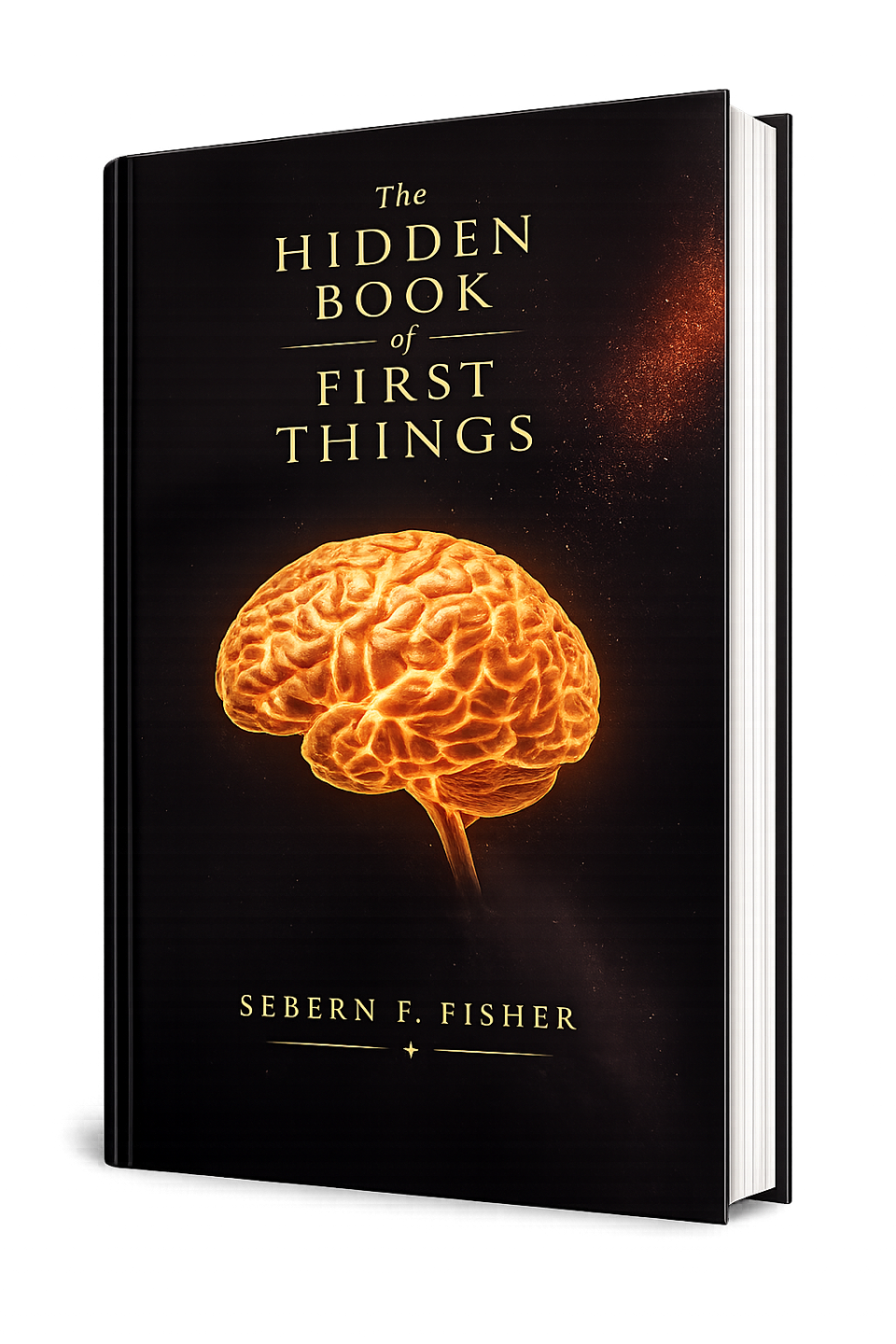
Available Now!
Purchase your copy of The Hidden Book of First Things below. Audiobooks & non-english versions available soon, and additional retailers are being added.



Read the Preface from 'The Hidden Book of First Things'
PREFACE
As you will come to see, this memoir is not about me. It is a memoir of becoming me. It is a memoir of the aftermath that almost everyone who has a history of severe childhood trauma suffers. It is a memoir of how a child’s mind develops when they lose their mother. It is a memoir of a profound therapeutic relationship and some may think, a radical ‘treatment’. It is a memoir of my brain and its alignments with the absence of my parents and its adaptions to events that I discovered while writing the journal this book depends on. Because it is taken from journals I kept over the years, this book unfolds in a facsimile of ‘real time’. You will learn what happened as I do.
It is a memoir about memory, in the mind, in the brain and in the body. It is about the experience of ‘body memories’ and the therapists who took me through them as they arose and arose again. It is a memoir about identity and a memoir about race. It is the story of turning slowly, almost blindly, toward what happened to me, what didn’t happen and what happened within me as a result. My interior world echoed. It had no landscape. There was no horizon.
There is an inescapable paradox in writing about the absence of self and other particularly, as I am doing, from within it. As you read, you may find yourself feeling lost, without bearings. If you can, join me there. Go with it. I am writing from the inchoate ‘presence of absence’ experienced in some way by every child whose mother has turned away. This is the core of early childhood trauma, not the events, the absence.
I think if I understood what others mean when they say recovery, this would be a book about recovery. But recovery is about disease. There is a state of wellness before the onset of illness that you return to when you recover. I could never find that state of wellness or wholeness. There was no ‘before’. There is no disease. And yet, I did recover. It was not will, or understanding. It was the triumph of life force when it is recognized, nurtured and challenged. Every one traumatized as a young child has no choice but to identify with what happened. ‘Healing’ from an identity may not be possible, but healing a brain injury is. As a colleague of mine said, “The brain privileges its own regulation. It has to.” This is a memoir of healing my brain and, directly as a result, discovering a mind.
The book begins in stanzas. You can read it as a tone poem. This is a memoir of interior life that is never, if it stays true, a story. I came into psychotherapy mummified by the stories I had, and often told, of significant mental illness. At some point I wrote, “The story was the container. It had protected me from seeing what the story was about.”
Arles, the therapist you will meet, recognized that I did not understand the tragedy of the story I told and more importantly he saw how little of ‘me’ there was telling it. He insisted on my presence in the room and that I recognize his; neither came readily. Establishing self and other had to be first order in the therapy. He saw me through episodes of flashback and cared for me in their aftermath. He taught me rules of relationship that I had missed. It is important to say that neither he nor I are recommending the psychotherapy that I am writing about. It underscores the need to establish attachment where it has failed.
In the course of the memoir, I learn that the traumatized brain is significantly different from one that is not. One difference is the failure of the Default Mode Network, the network that underwrites self and other in the brain. I didn’t have a self to bring to Arles and I couldn’t recognize the reality of a self in him. His insistence that I do so was crucial to its development. He became the being around which I began to scaffold my own. He was the spinal column. He gave me the template of self and other. But he could not give me the brain for it.
I met Ruth Lanius, the trauma researcher, in a workshop Bessel van der Kolk asked me to give on neurofeedback. I taught Ruth about neurofeedback and she taught me about the Default Mode Network. This network develops naturally when children are cared for well enough. Arles and I were trying to establish a brain network with psychotherapy. I don’t think it can be done. Neurofeedback quieted my brain and supported activation of the Default Mode Network. Without it, I would have lived within my prior adaptations to absence and fear.
Throughout my course of treatment I was a therapist treating trauma patients. When I felt the changes neurofeedback brought in me, I needed to learn it and offered it to my patients. I wrote a professional book on neurofeedback in 2014. This memoir brings you into the brain as it changes the mind. Neurofeedback is always the first thing to be ruled out. In this memoir it can never be.
The text will not always identify early changes I experienced with training my brain because I did not recognize them. One occurs in front of Ted’s Boot Shop: a fear of falling through plate glass. I had no recall of the session just before it. This reflects the instability of my brain as demand increased on it.
As my brain regulates, everything begins to quiet. I begin to recognize myself and Arles. I become more able to observe changes. Neurofeedback could shift states from terror to ease. I did have setbacks, often during absence. These states became central to the journal because they were hardest to bear. Over time this changed.
Neurofeedback opened the door to my brain and to other therapies: HBOT, HEG, The Listening Program, Symmetron, Nexalin, acupressure, Rosen Method, and trauma-informed physical therapy. All contributed. Meditation also developed, but only became usable as regulation improved.
This book is in your hands now. If you are a trauma therapist, I hope it informs your understanding. If you are a trauma patient, I offer interior experience. If you are a relative or friend, I hope it helps. Trauma is neurological before it is psychological.
Standard trauma treatments are failing traumatized patients. These patients are not failing treatment. They are often labeled “treatment resistant” when they are not. Both patients and therapists suffer in this process.
I wrote this memoir to describe the aftermath of absence and abuse from the interior of it and to lay bare its complexity. I wrote it to understand my brain and mind. I wrote to provide a narrative for a brain that cannot speak. When the brain is regulated, change follows.
The therapy I had with Arles is not replicable, but the understanding that developed within it informs therapy. The core dilemma is attachment failure and absence of a key brain network. Neurofeedback is replicable and should be accessible to those with developmental trauma.
One last important note: neurofeedback is not specifically a trauma treatment, but it can alter brain frequency patterns underlying consciousness itself. This is what I ask you to observe.
Conversations with Sebern Fisher
In this series of videos, Lars Vala and Sebern Fisher discuss the moments that inspired her memoir.

❝
The Hidden Book of First Things
Fisher invites you to join her on a transformative journey through absence, identity, memory, trauma and the development of Self and of Non-Self.
Reconstructing Identity
Fisher unfolds her unexpected discovery of 'Self' in the midst of multiple complex changes that arise when neurofeedback quiets her nervous system. She writes powerfully about an internal world that was a House of Mirrors that she could not choose to leave. Through therapy she learns that she is a collection of survival responses not a cohesive person. To her, no one else including Arles, her therapist, has a 'real self' either. She lived in a world, such as it was, of shadows and echoes in a House of Mirrors. And yet she worked every day as a therapist who helped her patients, to a great degree because she understood that they too lived in a world like this.
Understanding Memory
Trauma is not a narrative. It is an experience made of sensory fragments encoding during periods of profound distress. The past isn't just remembered, if it is at all, but it is re-lived in echoes of those fragments. For reasons Fisher will uncover, cognitive memory cannot be trusted. When trauma creates a void where safety should have been, we can spend a lifetime trying to fill that emptiness with noise or distraction. Instead we need a steady, witnessing presence. When we quiet the reactivity of the nervous system we can begin to inhabit that presence and find our way to the "here and now". We can begin to feel safe and to live in the present, not the past. She includes this quote from Thay: "We fall back into the past, we leap ahead into the future and in that we lose our entire lives."
Trauma & Absence
Trauma is a physiological state the brain/body cannot organize or calm. They are hijacked into a state of terror, often subliminal, for the sake of survival. Fisher confronted this reality in herself in the safety of her therapist's office. Through therapy, neurofeedback and body work it became clear that trauma and pervasive parental absence live in the rhythms of the brain and body and needed to be addressed there. The mind reported them but could do little to change them. Early attachment ruptures shaped these rhythms, and disrupted the brain's inherent ability to soothe itself and to encourage connection with others. In using neurofeedback for herself and her patients she discovered what the regulation of the brain could do, not just for survivors of trauma but for anyone who wanted to optimize their brain.
A Path to Healing
Recovery requires a change in the physiological and functional architecture of the brain. Psychotherapy alone cannot provide this. Fisher, herself a psychotherapist specializing in treating traumatized adolescents and adults, shares the evolution of her own thinking through her first-hand experience. Her accounts are vivid, sometimes painful and always deeply personal. She writes insightfully and warmly about the parallel experiences her patients are having before and after she trains their brains. One such patient who arrived in her office with many different personalities told her, "I'm now just your run of the mill PTSD", and she attributed her integration to neurofeedback.
Fisher also describes other paths she took to resolve the horror and confusion that could grip her, including body work (often the most difficult memories surfaced through the body), and Hyperbaric Oxygen Therapy along with ongoing deep and sometimes stormy psychotherapy.
Perhaps the most significant change that we watch as it takes hold, is the development of a sense of self which comes together through therapeutic attachment, neurofeedback, body work and at the end, DBR. We listen in to her conversations with Marsha Linehan, author of Dialectical Behavior Therapy who she has known since they were kids. They agree about very little. She has written too about her relationship with Thich Nhat Hanh (Thay), her root teacher in Buddhism and how, for her, neurofeedback led to an egolessness which he would call Not Self. Toward the end of his life, she helped Thay work with his brain using neurofeedback after his devastating stroke.
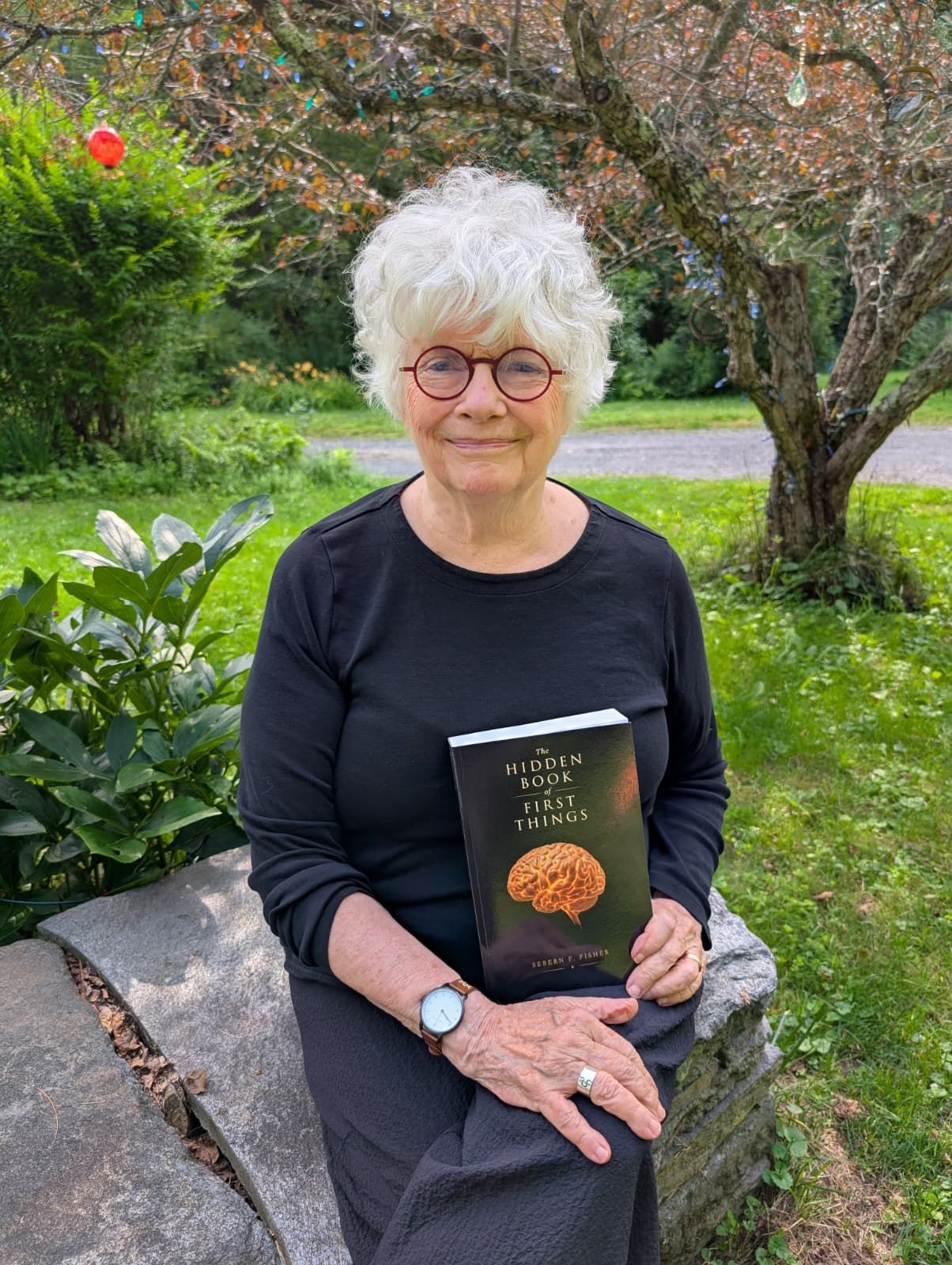
Fisher has said that she would never have written The Hidden Book of First Things were it a story unique to her. If you have endured parents who turned away, with or without the abuse that typically follows, this, she says, is your story too.
🌿
A Gift for Your Practice & Clients
Join our community newsletter to receive updates about the book and events Sebern is hosting on EEG Learn and other platforms.
Keep Me Updated