
Sebern Fisher, MA, LMH, BCN
Psychotherapist, author, and mentor specializing in developmental trauma and neurofeedback
Subscribe for UpdatesSebern Fisher has been integrating neurofeedback and psychotherapy into the treatment of those with developmental trauma for the last twenty years, and in recent years has begun exploring DBR in the treatment of Trauma.
Sebern was the clinical director of a residential treatment facility for severely disturbed adolescents for 17 years. During her tenure she introduced attachment theory and dialectical behavior therapy to the milieu. She is presently in private practice where she provides neurofeedback, psychotherapy and consultation. She trains nationally and internationally. She is a published author, speaker, and strong advocate for brain-based healing.
Areas of Specialty include: Developmental Trauma, Neurofeedback, Deep Brain Reorienting, Brain Therapy, Trauma & The Brain
Is Therapy Enough?
Psychotherapy and the Brain with Sebern Fisher
We had a great community event with Sebern Fisher considering the relationship between psychotherapy and brain-based modalities. Add EEGer Sip & Read to your library for free to catch up on this and other community events with Sebern.
Add to Your Library
Hidden Book of First Things
Explore Sebern's New Memoir, Read her Reflections, and Engage with Sebern in Community Events

Leave A Review!
If you are reading Sebern's memoir, please take a moment to leave a review. You can help spread the word about this critical work!
Leave a ReviewSebern Fisher's Reflections
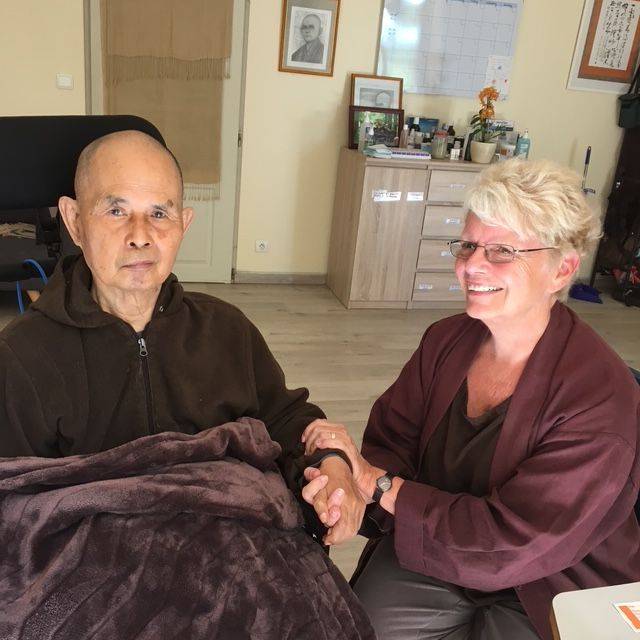
On Meditation
Sebern reflects on her time with Zen Master Thích Nhất Hạnh, Plum Village, and Maitri Meditation
Sebern on Meditation
In 1990 I went to the first retreat Thích Nhất Hạnh offered at Plum Village, his retreat center in southern France. As a young therapist I had mastered the importance of Self and the psychological intricacies of its development. Now, twenty years, I began to hear people talk about the Buddhist perception of "No Self". At first, I rejected this absurd idea out of hand. As you will see, I tend to do that. There were other influences but none so compelling as a photo of Thích Nhất Hạnh in the magazine Common Boundary which was devoted to the confluence of psychotherapy and spirituality. I knew immediately that this man had something to teach me.
This is a retreat for psychotherapists and Vietnam vets in the home of a Vietnamese diaspora and Thích Nhất Hạnh’s retreat center, Plum Village. That war as it was waged in me, at Columbia and on the streets of New York, is fresh and raw. I watch the men who I think are vets. Vietnamese is the first language here. The rain beat relentlessly on the metal roof.
“We fall back into the past, we leap ahead into the future, and in that we lose our entire lives.”
When Thầy finished speaking, I was crying and smiling at the same moment. He tells us to rest.
I come to measure the speed of my mind in judgments per second. I envy the ‘in group’ for their specialness, for their comfort with each other and with being here; for leaving me out, the fat child.
Maitri Meditation
Monday: Loving kindness and deep, clear sadness seem inextricable. Sadness does not feel at all like suffering.
Tuesday: Constant pushing to keep my heart open; not to be embarrassed by the migraine; not to be ashamed of asking for help. I talked with Evelyn who told me that it was beginning to get harder for everyone she’d spoken with. She reminds me of what I’ve just told her: This is my first retreat, I don’t speak any of the languages including Buddhist, I am alone in the Middle Hamlet.
Wednesday: I can hardly lift my body. I went into that semi-hallucinogenic state for two hours. Margot’s arrival interrupted me. As I lay in my bed, not yet dressed, she taught me a bit more about Buddhism and its cultural adaptations. She encouraged me to come with her and the others to Bergerac. We walked through the farmers’ market, looked in shops on the side streets
and stopped at the sound of every bell, the quickly established practice of Plum Village. There were many bells. I bought a washcloth.
Thursday: Writing practice with Natalie. Her instructions are “Keep your hand going, come from first thoughts, you are free to write the worst shit in the world...” Her first prompt was “I remember...” We wrote from that for fifteen minutes. Her second prompt was “I don’t remember...”

On Psychotherapy
Sebern discusses her relationship with her long-term therapist, including her discovery of her lack of self
Sebern on Psychotherapy
I called Arles in early November after a brief return to Westchester to talk with my uncle and with Kate, our caretaker. She talked about my mother’s affair, an affair evidently going on before my father’s death. She told me that my father gave my brother sleeping pills to keep him from wandering in the night. Hugh slid down the drainpipe outside his room and took my mother’s car. She called Kevy a “walking rip,” meaning, in Irish, that she was angry and “spoilt”. She said we were all spoilt, running wild, our parents involved with themselves too much. Too much alcohol. Too many parties.. Too little attention. My uncle spoke freely, as if to a biographer, about my father’s long affair with his secretary. My mother once referred to a fling he’d had and had, at least to me, written it off to the nature of men. He also told me that my dad was involved in tax fraud. My mother once said that they were audited every year because my father turned in an agent for attempted bribery. I hadn’t known any of this. I told my friend, Eva. “You went to Westchester to open some doors that you know you need towalk through.”
I heard a door open, then softly close. It was ten minutes past the hour. I sat in the waiting room at the end of the long hall that had taken me, I assumed, past his office door. I folded my black pea coat over my lap and looked straight ahead at the wall. Then I tried to read the New Yorker with the torn cover. I heard a door open at the far end and footsteps approaching. I gathered my coat closer and shoved it, bunched under my arm, as I rose to shake his hand. His grip was secure. He was tall, lean, almost angular and dressed in black silk trousers, black T and black silk jacket.. His greeting was warm.
It was his voice that brought me there, like a promise. I’d responded to a flier for a dream group for therapists. I would tell the dream of the iridescent orchid. He described his thoughts about the group, but I heard only the resonance and depth of his voice. I asked to be his patient. I sank into his dark windowless office, two black leather chairs and a long black analytic couch, soft headrests at both ends; a smell of Twinings tea and vanilla; incense; books around the ring base of his chair -- Adrienne Rich, Buddhism, Lacan. I sat on the middle cushion of the couch and lay my coat down beside me. The silence pooled around my ears.
“I am swimming slowly down into a translucent sea, circling around a lucite pillar, no equipment but my body, taking air from within the water. No desperation; no fear; slow, steady, circling downward.”
“Fetal fish.” His voice was silk.. He startled me.
“I want to go beneath the story. I am trapped in my story.”
“Yes, we shall go there, but I think first you need to tell me the story.”
Arles insisted that I recognize what I wanted him to see- the stark absence at the core of my being. This was not the No Self of Buddhism, it was the no self that one is left to build themselves around when their parents turn away. I could not do this, no one can, without the Other. Slowly and painfully, that's who Arles became..
Wilding
“Last night I was leaving my office after my last patient. A group of boys was collecting near the firehouse. I suspected they were going to do a ‘wilding.’” This tumbled out of me, anxiously. “I thought about going to the police, but there wasn’t anything to report. Just my intuition, so I didn’t. I saw in the paper this morning that a couple was ‘wilded’ coming out of Beardsley's. I feel terrible. I could have stopped it.” He didn’t pause.
“Tell me about the wilding in you.”I felt blinded in the beam of a floodlight, suddenly, irreparably, exposed. She was eating from the dumpster, and when they went to catch her she bit, kicked, ran, afraid she would never be caught. I knew her. It was not me. It was not me who lit fire to the tender flesh, a vindictive act, not one of containment, one of hatred. A hole in my arm. I knew I was not lying when I took no responsibility for the burn. Not me at all. Her.
Arles was angry. I paced. I threatened the stupid family sculpture. He grabbed my arm and yelled at me.
“Either you sit down on the couch now or the session is over.” The threat seemed suddenly overwhelming. He had my forearm. I arched and ordered him to let me go. Imperious. He repeated the terms. I felt the crumbling of resolve. He guided me, not gently, to the couch and I sat, sullen, contemptuous, relieved.
He pulled the chair right in front of me and sat down without his usual grace.
“Are you pissed?” I asked him, looking at my feet.
“You bet I am!”
I moved back on the couch. “I want to get this... but it’s not your anger. That’s your part in the script, the script that somehow I’ve written.”
“I know this,” he said, still angry, “and it is a profound problem. I am subsumed by the absence in you.”
“At best, Arles, I hear a far echo.”
“Cavernous, Sebern, cavernous.”

On Marsha Linehan
Sebern explores her connection with Marsha Linehan, from meeting in a seclusion unit to a deep friendship
Sebern on Marsha Linehan
I met Marhs Linehan when she was nineteen in a seclusion room on the unit for the most disturbed patients at The Institute of Living. I was newly admitted and afraid. She had burned herself so often that she was not allowed to smoke and I was not permitted to share my cigarette with her. She asked me to blow smoke into her mouth. This is how we met. Over the years we shared stories from the many months we spent there, as people do the memories of their childhoods. She had very few to remember.
Marsha
Until she begins to talk about the soul or allows a gentle moment of tearful grief, Marsha renders her humanity and all others like a puzzle reduced to learning contingencies and neurons. She discounts mystery, but then there is a mystic depth. Her external mood never waivers. She wakes up talking and drifts off listening to NPR. She wears the white coat of her science, a science discredited by scientists, with humble pride. She has no snobbery. We accuse each other of certainty but embedded in our certainty is the certainty that nothing is certain; that we are most likely, not certainly, wrong.
She does know a lot. She has the capacity for desire and believes her ambition is sated by the treatment she has developed and the book she published. She does not practice, but she does take long retreats with her beloved teacher, Wiligus, and takes pride in her koan status. I open my mind to it but find it hard to see her, as taken as she is by distraction and motion, as a senior student. Like me, she takes comfort in the material – it is the only trusted embrace. She aches, deep below the ample shapely flesh, beneath the broad scarred bones. She has no patience with attachment theory -- ‘there is no data’ -not even her favorite photo of herself with her mother when she is three or so and reaching for her as her mother looks away.
“Your favorite picture, Marsha?” This discussion dies.
She is funny, opinionated and non-dogmatic. She loves her students as fiercely as any mother loves their children – protectively, expansively, harshly. She demands they scrub behind the ears and takes over if they’ve missed a spot. She takes no credit for them, but they are like children, forever “my students”, regardless, I assume, of their age, independence, or status on the globe.
She is generous, big-hearted in her way, but she is wary of her impulse toward spontaneous generosity. She praises God for coffee, flowers and email. She reports sudden ‘joy attacks.’ She was born to teach and she, like others, breathes in, out, thousands of unnoticed times a day. She forgets and despite a deep empathy -- we talked about this -- she is insensitive and can leave a wake of small miseries behind her. I looked back at the saleswoman in the soap store after Marsha concluded the sale and she was looking confused and angered. I tried momentarily to imagine how Marsha had insulted her. I looked at my friend, oblivious to any pain she’d created, back at the saleswoman who caught my glance, smiled and shrugged.
I love Marsha and I loved her the most in the deepening night on Camano Island when she dropped from her constant almost chipper tone into tears. We’d been talking about the situation in my neck and the worst of the dire prognoses.
“If what happened to you happened to me,” she said, “no one would care for me. No one.”
I wanted to protest, to reassure. I wanted even more to taste the tears, to have this moment, the silent moment of silent tears, no comment, no understanding, nothing but the candlelight and the love that held us through. I am grateful for that moment. It eclipses all others on the island.
Learn with Sebern Fisher
Explore our collection of past workshops & trainings with Sebern Fisher
Finding the Path
Clinical Mentoring Group
Sebern Fisher invites you to join EEGer for a six-week mentoring group about exploring and understanding trauma treatment. Ask questions, bring your cases, and learn in conversation with experienced NFB & DBR providers.

Recovering From Stroke
1-Hour Webinar
Following a rare and typically devastating cerebellar stroke, Sebern Fisher shares through lived experience and informed clinical observation how neurofeedback and related brain-based therapies supported an unexpectedly rapid recovery.

Trauma 24 Conference
On-Demand Conference Recordings
Discover the latest research & findings into neurofeedback and Deep Brain Reorienting (DBR) with keynote presentations from Sebern Fisher, Dr. Frank Corrigan, & Dr. Ruth Lanius.

Brain Therapy
1-hour webinar
Sebern Fisher explores attachment shock's role in developmental trauma and how therapists & researchers are combining Deep Brain Reorienting (DBR) with neurofeedback for promising results.

Trauma and the Fear-Driven Brain
Insights from Sebern Fisher on Trauma
Explore how early trauma impacts brain development, how neurofeedback and psychotherapy are used to treat trauma, and the essential role of the therapeutic relationship in recovery.

Developmental Trauma Course
16-Session Webinar
In 16 illuminating lectures, Sebern Fisher explains the neuroscience and therapeutic skills that have been transformative for people living with the histories of developmental trauma.

Attuned Neurofeedback Summit 2025
On-Demand Conference Recordings
Recordings from the multi-day conference and community event hosted in Hunter Valley, Australia. Focused on neurofeedback, the community, and the latest in trauma-focused modalities.
Follow Sebern Fisher’s Work with EEG Learn
We'll keep you posted on new classes and special offers.
Sign Up for Course UpdatesSebern Fisher's Published Works
Sebern Fisher has made many contributions to the community in the form of articles and reflections, and is the author of Neurofeedback in the Treatment of Developmental Trauma.




Recommendations from Sebern Fisher
These workshops & on-demand classes are a great way to explore similar topics with other presenters.


 Stay In the Loop!